Crisis of Men’s Health
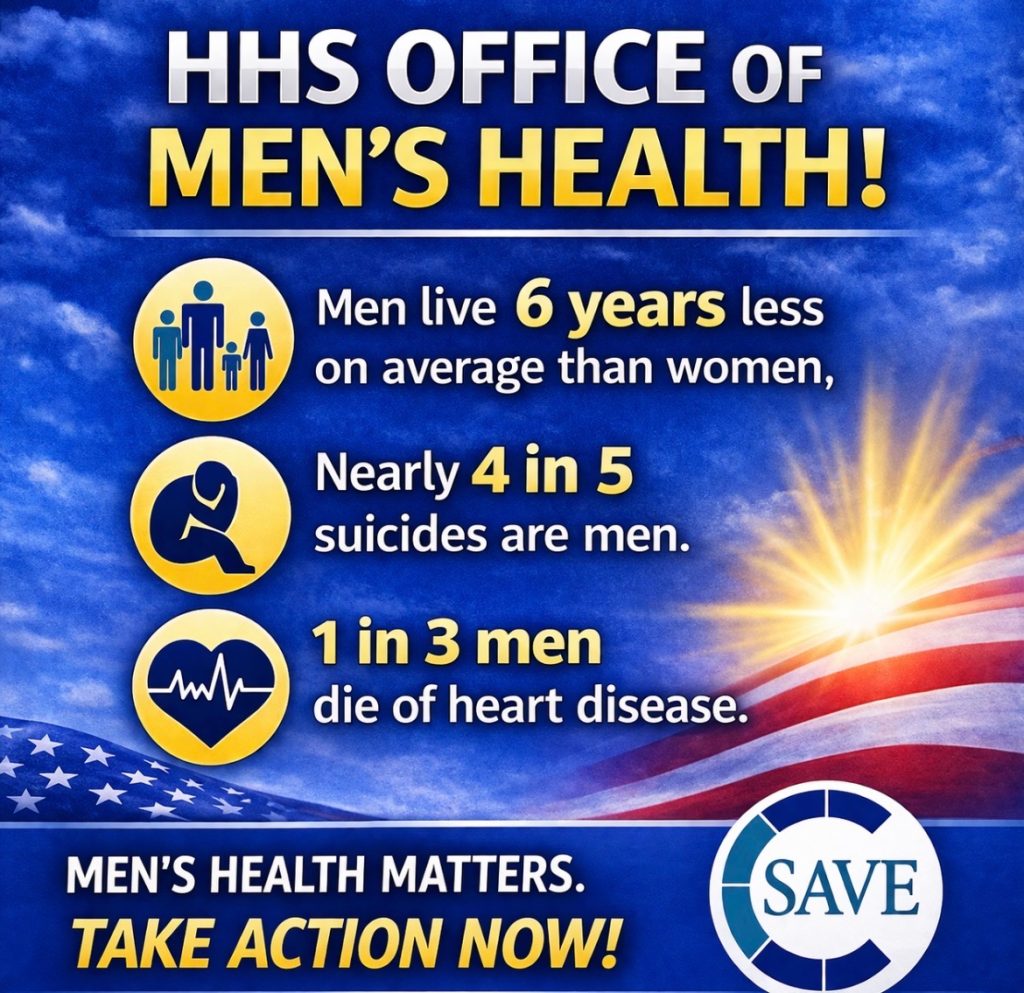
CALL TO ACTION: Men are dying five years sooner than women. But deplorably, the U.S. Dept. of Health and Human Services has SEVEN offices of women’s health, and ZERO offices of men’s health.
Assistant Secretary for Health Brian Christine regularly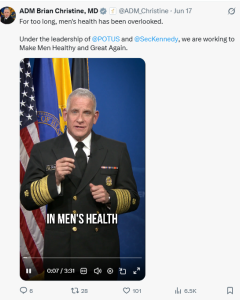 states on his Twitter account his support for men’s health. But he faces opposition within his own department.
- Video of leading women dishonestly claiming that woman were routinely excluded from medical research.
Tell Dr. Christine to ignore the nay-sayers, and act now to create the first Office of Men’s Health. The clock is ticking on men’s lives — do it now:
-
- Twitter: https://x.com/ADM_Christine
- Email: ASH@hhs.gov
- Telephone: 202-690-7694
OVERVIEW
- Men face a shorter lifespan than women, by over 5 years.
- The suicide rate for males 15-24 years-old rose by 26%, from 2010 to 2023.
- Each year, 200,000-250,000 men ages 25-64 die from accidents, heart disease, suicide and other causes. These causes are largely preventable.
- The annual lost productivity due to these deaths exceeds $400 billion annually.
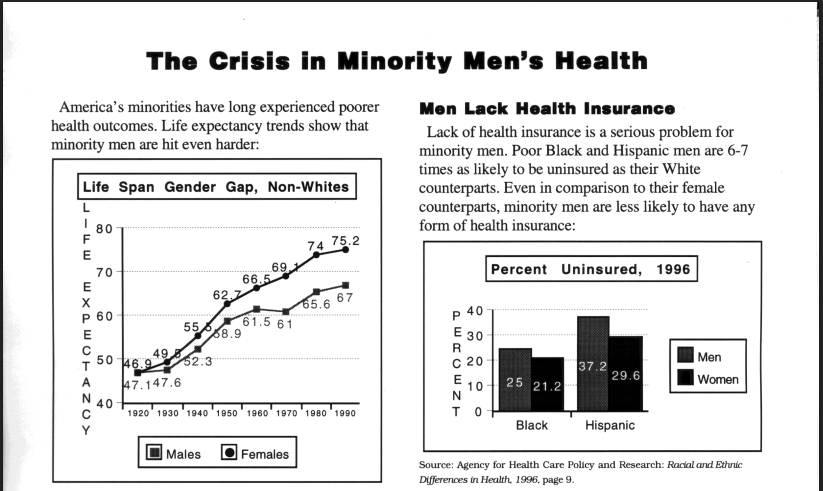 The crisis for racial and ethnic minorities is especially severe.—>
- Information about International Men’s Health Week, celebrated in June.
LEGISLATIVE INITIATIVES — FEDERAL LEVEL
- American Medical Association: Resolution to Establish Federal and State Offices of Men’s Health
- Articles:
- Annalisa Merelli: Momentum Builds for a Federal Office of Men’s Health
- Dominick Shattuck: A Turning Point for Men’s Health Policy in North America?
- Dominick Shattuck: Why the U.S. Needs a Federal Strategy on Men’s Health
LEGISLATIVE INITIATIVES — STATE LEVEL
Efforts currently are underway to establish men’s health programs around the country:
-
- California: Assembly Bill 1956 will amend the state Health and Safety Code to list boys and young men as a priority population of the Office of Suicide Prevention.
- Maryland: House Bill 341 to establish a Maryland Commission for Boys’ and Men’s Health.
- Virginia: SB447 to create an Advisory Commission for Boys and Men. Signed into law on April 13, 2026!
- Dominick Shattuck: Mapping Boys’ and Men’s Health Policy Activity Across the United States (2015–2026)
WOMEN ARE AFFECTED BY PREMATURE MALE MORTALITY
- Casey Walker: Why Women Should Be Passionate About Men’s Health
- Affected Areas:
-
- Emotional and psychological trauma from bereavement
- Increased burdens of daily living
- Higher out-of-pocket medical expenditures
- Elevated poverty risk
- Three times greater risk of being admitted to a nursing home
- 48% greater risk of widowhood mortality
OFFICES OF WOMEN’S HEALTH
The U.S. Department of Health and Human Services has seven offices of women’s health, and no offices of men’s health. Below is a listing of each women’s office, indicating the year that office was established, the FY 2025 budget, and name of the current director:
- 1990: National Institutes of Health: $100 million.
- Director: Janine Austin Clayton, M.D.
- 1991: OASH Office Women’s of Health: $34.1 million
- Director: Dorothy Fink, M.D.
- 1992: Substance Abuse and Mental Health Services Administration: $39-44 million for Pregnant and Postpartum Women treatment programs and $3.5 million for a Women’s Behavioral Health Technical Assistance Center.
- Director: Nima Sheth, M.D., M.P.H.
- Offices with no stand-alone budget reported:
- 1989: Agency for Healthcare Research and Quality
- Director: Emily Chew, MPH
- 1994: Food and Drug Administration: Estimated to be in the low millions.
- Director: Kaveeta P. Vasisht, M.D., Pharm.D.
- 1994: Centers for Disease Control
- Director: Wanda Barfield
- 2000: Health Resources and Services Administration, Maternal and Child Health Bureau
- Director: Shirley Payne, PhD, MPH
- 1989: Agency for Healthcare Research and Quality
Patient Protection and Affordable Care Act
In 2010, President Obama signed into law the Patient Protection and Affordable Care Act, also known as “Obama Care.” The law includes Section 3509, “Improving Women’s Health,” that codified the establishment of the offices of women’s health in five departments: DHHS Office of the Secretary, AHRQ, CDC, FDA, and HRSA. The law also requires the establishment of an HHS Coordinating Committee on Women’s Health.
False Claims of Female ‘Exclusion’ and ‘Underrepresentation’ from Research
Melinda French Gates: “We have funded men’s health issues for a very long time, but we have under-funded and under-researched conditions that affect women.”
Judith LaRosa and Vivian Pinn: “The exclusion of some women in clinical research may sometimes be valid, but not all the women all the time,” (American Medical Women’s Association, 1993. Vol. 48, pages 145-151).
Marcia Angell: “There is little doubt that women have been systematically excluded as subjects for study.”
The Truth:
-
Men Are Good: The Women’s Health Narrative Meets the DATA
- Edward Bartlett: Did Medical Research Routinely Exclude Women?
- James Nuzzo: Women Are Not “Understudied” or “Underrepresented” in Medical Research
- James Nuzzo: NIH Funding of Men’s and Women’s Health
- General Accountability Office: “GAO found that women were a majority of the clinical trial participants in the new drug applications (NDA) it examined, and that every NDA included enough women in the pivotal studies to be able to statistically demonstrate that the drug is effective in women.”
INTERNATIONAL
- Articles:
- Global Action on Men’s Health: Delivering Men’s Health
- European Union: The State of Men’s Health in Europe
- Morna Cornell: Men’s Health Policies: Long Overdue
- ICMB: The Power of Men’s Health (Powerpoint)
- Comprehensive Men’s Health Plans:
- Australia: National Men’s Health Strategy
- Brazil: National Policy of Comprehensive Healthcare to Men (PNAISH)
- England: Men’s Health: A Strategic Vision for England
- Europe: Strategy on the Health and Well-Being of Men in the WHO European Region
- Ireland: National Men’s Health Policy, 2008-2013; National Men’s Health Action Plan, 2017-2021; Second National Men’s Health Action Plan: Healthy Ireland – Men [HI-M] 2024-2028
- Malaysia: National Men’s Health Plan of Action, 2018-2023
- South Africa: National Integrated Men’s Health Strategy, 2020-2025
OTHER
- Fathers:
- Edward Bartlett: The Effects of Fatherhood on the Health of Men: A Review of the Literature
- Andres Villaveces et al: Orphanhood and Caregiver Death Among Children in the United States
- Suicide Prevention:
- Allison Parshall: Young Adult Suicide Rates Dropped After U.S. Launched 988 Hotline
- Tom Golden: How Finland Faced Its Suicide Crisis Head-On
- Tom Golden: Finland Acted, America Shrugs
PRESS RELEASES
2026:
- August 3: Anthony Fauci and the Culture of Dishonesty at the NIH
- July 20: Feminists Amass Billions as They Spread Falsehoods About Medical Research
- July 13: $20 Billion: Latest Scare-Tactic of the Women’s Health Lobby
- June 15: Women Are Some of the Strongest Supporters of Men’s Health
- June 8: Five-Year Life Expectancy Gap Faces Hostility and Neglect
- April 30: Men’s Health Programs: Proven Effective in Reducing Male Mortality
- April 23: Virginia Becomes First State to Create Commission for Boys and Men
- February 26: Growing Momentum Across the Nation to Remedy ‘Crisis’ of Men’s Health
2025:
- December 3: American Medical Association Passes Resolution to Establish Offices of Men’s Health
- July 23: 60 Organizations Call on DHHS to Promptly Establish Office of Men’s Health
- April 30: Women Not ‘Excluded’ or ‘Underrepresented’ in Medical Research: Report